• Expert Support
  • Dealer Solutions

Shop Allison Diagnostic Tools

Allison DOC is the OEM diagnostic and programming software for Allison automatic transmissions across the 1000, 2000, 3000, and 4000 series. Read codes, monitor live data, run shift adapt routines, check fluid life, and load calibration files for vocational and on-highway applications.

  • OEM Transmission Software
  • 1000 / 2000 / 3000 / 4000 Series
  • Calibration Files
  • Shift Adapt & Fluid Life
Professional DiagnosticsOEM-level capabilities for commercial trucks, buses, ag, construction & more.
Expert SupportU.S.-based technicians with dealer and fleet experience ready to help.
Ready-to-Run KitsPreconfigured software with everything you need to get up and running fast.
Financing Available0% APR options available on qualifying orders over $1,500.

Featured Allison Products

View All Allison Products →
Why Choose Allison?

  • Comprehensive vehicle coverage
  • OEM-level diagnostics & programming
  • Regular software updates & releases
  • Rugged hardware built for the shop
  • Backed by HDT expert support
OEM-Level Diagnostics
Wide Vehicle Coverage
Bi-Directional Controls
Programming & Coding
Active Software Updates
Trusted by Professionals

Shop Allison by Category

Find the Right Allison Tool

Answer a few quick questions and we'll help you find the best tool for your shop's needs.

  • Personalized Recommendations
  • Expert Guidance
  • Fast & Easy

Trusted by Shops & Fleets Nationwide

★★★★★

"Allison gives us the coverage and reliability we need. HDT support is second to none."

Mike R.Diesel Tech — Midwest Fleet
★★★★★

"The software is powerful and easy to use. Programming and diag in one platform saves us time and money."

James T.Shop Owner — Texas
★★★★★

"HDT's ready-to-run kit had everything we needed to get started right out of the box."

Sarah L.Fleet Manager — California
★★★★★

"Great tools, great support, and fast shipping. Our go-to for heavy duty diagnostics."

David P.Lead Tech — Florida

Powerful Diagnostics. Proven Performance.

Engine Diagnostics
Transmission Diagnostics
ABS & Brake Systems
DPF & Emissions Regeneration
Bi-Directional Controls
Calibrations & Programming
Parameter Changes

Capabilities vary by tool, software license, vehicle, and manufacturer requirements. Contact HDT to confirm compatibility.

Expert Phone SupportU.S.-based technicians
Setup & Training HelpGet started with confidence
Fast ShippingOrders ship same day
Warranty & SupportBacked by HDT
0% APR FinancingOn qualifying orders

Allison is the transmission you call about when the truck stops working but the engine is fine. The 3000 and 4000 series sit under the floor of nearly every refuse packer, fire pumper, transit bus, school bus, and concrete mixer in North America. The 1000 and 2000 series cover the medium-duty space — Duramax-equipped pickups, box trucks, shuttle buses, smaller utility chassis. If you service any of those segments, you cannot dodge Allison. The fault codes won't pull on a generic OBD scanner, the fluid level routine isn't on a dipstick, and the shift adapt and TCM flash work only happens through the OEM software. That software is Allison DOC.

This page covers what Allison actually builds, where you'll see those transmissions in the field, what the DOC software tiers do (and don't do), what RP1210 adapter you need to drive it, and what we recommend for shops that touch refuse, transit, school bus, fire/emergency, and vocational work. Allison is not Eaton-Fuller territory. You will not see an Allison 4000 hooked to a 15-liter linehaul tractor pulling reefer freight from Laredo to Chicago. That market belongs to UltraShift Plus, Endurant HD, mDRIVE, and I-Shift. Allison wins where the duty cycle is stop-and-start, where PTO drives a pump or a hopper, and where the operator is a firefighter or a bus driver, not a career OTR driver. Knowing that distinction up front saves you from quoting the wrong tool for the wrong shop.

Need help matching a kit to your fleet mix? Call 866-217-0063. We do the matching on the phone in about ten minutes — no quote forms, no callbacks tomorrow.

Who Allison Is

Allison Transmission is headquartered in Indianapolis, Indiana. The company started in 1915 as the Allison Engineering Company, became part of General Motors in 1929, and then split off as a standalone publicly traded company (NYSE: ALSN) in 2013. That GM history matters for one practical reason: the 1000 series transmission you'll find behind a 6.6L Duramax in a 2500HD or 3500HD pickup is an Allison, and the TCM under the dash speaks the same diagnostic protocol as the 3000 series in a refuse packer. Different sizes, same family.

Allison's market position is dominant in fully automatic medium- and heavy-duty commercial transmissions. They are the default spec on most North American fire apparatus, most transit buses, and a very large share of school buses, refuse packers, and concrete mixers. The reason is duty cycle. A torque-converter automatic with a planetary gear set handles thousands of stop-and-start events per shift better than a manual or an automated manual ever will. A garbage truck makes 800 to 1,200 stops a day. A fire engine sits at idle in pump-and-roll mode while a PTO drives the water pump. Allison was built for that kind of service from the ground up, and it shows in their parts availability and their service network.

The Series Lineup

Allison's product structure is organized by series. The number roughly tracks GVW capability and torque rating. Here's the practical breakdown:

1000 Series. Light- and medium-duty. Up to 365 hp and 700 lb-ft input torque, GVW capability around 33,000 lbs. This is the transmission behind the 6.6L Duramax in GM 2500HD/3500HD pickups, in some Class 4 and 5 chassis cabs, and in a lot of medium-duty service trucks. Six-speed automatic. If your shop sees a lot of fleet pickups, you need 1000 series coverage.

2000 Series. Medium-duty. Similar architecture to the 1000 with higher input ratings and a 9-speed variant capable of up to 380 hp and 900 lb-ft, GVW around 57,000 lbs. Common in box trucks, shuttle buses, smaller refuse trucks, walk-in vans, and similar medium-duty work.

3000 Series. The vocational mainstay. Up to 450 hp and 1,250 lb-ft, GVW up to 98,100 lbs. Six forward gears. This is the bread-and-butter transmission for distribution, refuse, fire/emergency, transit bus, school bus, and utility work. If you only buy one Allison kit, build it around 3000 series coverage.

4000 Series. Heavy-duty vocational and Class 8 vocational. Up to 800 hp and 2,360 lb-ft, GVW up to 242,550 lbs. Found behind Cummins L9, X12, X15, and Detroit DD13 in heavier refuse packers, larger fire apparatus, articulated dumps, motor coaches, and military chassis.

6000, 8000, and 9000 Series. Off-highway and severe-duty. The 6000 hits 1,025 hp. The 8000 covers energy and mining work up to 1,200 hp. The 9000 reaches 3,200 hp and 9,000 lb-ft for haul trucks, oilfield rigs, and heavy cranes. There is also FracTran for hydraulic fracturing service, which DOC Premium now supports. Most independent shops will not see these every day, but if you serve a quarry, a mine, or an oilfield service company, the same DOC software covers them.

Allison also builds electric and hybrid lines — eGen Flex, eGen Force, eGen Power — for transit and vocational electrification work. These need DOC Premium configured for H 40/50 EP and eGen Flex System controllers, which talk J1939 to the diagnostic tool.

Where You'll See Allison

Knowing the application tells you how the transmission was specced and what's likely to fail. Here's the field map:

Refuse. 3000 series on side-loaders and rear-loaders, 4000 series on front-loaders and roll-offs. Massive stop-count duty cycle. Expect to see worn shift quality complaints, FuelSense Neutral-at-Stop tickets, and PTO-related TCM faults. Refuse fleets live in DOC.

Fire and Emergency. 3000 EVS (Emergency Vehicle Series) and 4000 EVS. Pump-and-roll capability, integrated PTO control. Often equipped with retarders. These trucks sit for weeks then run hard, so cold-start TCM communication issues are common. Calibration verification matters because fire chiefs want every truck identical.

School Bus. Mostly 3000 series, with 1000 and 2000 in smaller Type A buses. Annual state inspection cycles drive a lot of the diagnostic work. School districts run lean — they want fluid life prognostics pulled and reset, not surprise overhauls in February.

Transit Bus. 3000 and 4000 series, plus growing eGen Flex hybrid and eGen Power electric installations. Transit shops are usually unionized, well-equipped, and run their own DOC seats. Independent shops get the overflow work and the contract maintenance.

Vocational Dump, Concrete, Tow, Crane. Mostly 3000 and 4000 series. Heavy PTO use. Shift quality complaints under load are common, and a lot of "transmission" tickets turn out to be calibration mismatches between the engine ECM and the TCM after a swap.

Military. X1100 and other X-series combat vehicle transmissions, plus standard 3000/4000 series in tactical wheeled vehicles. Independent shops generally don't see these unless you have a government contract.

Motorhome. Class A diesel pushers run 3000 and 4000 series. RV owners are a price-sensitive crowd that often DIYs through forums until they hit a TCM fault that needs DOC. Then they call you.

Allison DOC — The Software

DOC stands for Diagnostic Optimized Connection. It is a Windows-based application, currently distributed as a subscription license, and it is the only Allison-authorized tool for full diagnosis, calibration, and TCM flash programming. Generic scanners read some Allison fault codes through J1939, but they cannot run shift adapt, they cannot reset fluid life or filter life prognostics, and they cannot flash a TCM. For that you need DOC.

The current product family includes several tiers. The naming has shifted across releases — what some catalogs call "Standard" is now packaged inside Premium, Premium + Flash, Fleets, and Classic variants. The practical breakdown:

DOC Premium. Full diagnostic feature set for 1000, 2000, 3000, 4000 series, TC10 product family, and select off-highway. Read and clear DTCs, view live data, run shift adapt, view failure records, run fluid and filter prognostics, edit certain customer-modifiable parameters. No TCM flash.

DOC Premium + Flash. Everything in Premium plus the ability to flash 5th and 6th Gen TCMs with new calibration files. This is the version a real diesel shop wants. Without flash capability you cannot install updated calibrations or recover a TCM after a hardware swap.

DOC Fleets. A scaled-down package aimed at private fleets, national accounts, and municipalities running their own service bays. Supports 5th and 6th Gen TCMs. Less complete diagnostic depth than Premium, but enough for routine fleet maintenance and most fault-clear work.

DOC Premium for H 40/50 EP and eGen Flex. Hybrid and electric variant. Adds J1939 reading on the H 40/50 and eGen Flex system controllers.

DOC Classic. Legacy support for pre-4th Gen 1000/2000, WTEC II, WTEC III, and CEC controls. If you work on older transit fleets or older fire apparatus, you need this.

All current DOC versions support 6th Gen Controls cybersecurity functions, which require either online activation or a USB dongle for high-security operations. Allison pushes data file updates regularly through the DOC update server — typically several pushes per year — and a current subscription is required to receive them.

Adapters and Hardware

Allison DOC is RP1210C compliant. That means it will work with any vehicle communication interface that ships an RP1210C-compliant driver. In practice three adapters cover almost every shop:

Nexiq USB-Link 3. The default in most independent diesel shops. Wired and Bluetooth versions both work with DOC. If your techs already use USB-Link 3 with Cummins INSITE, Detroit DDDL, JPRO, and PACCAR ESA, it will plug straight into Allison DOC with no additional hardware.

Noregon DLA+ 2.0 / 3.0. Slightly faster on the data link, popular with fleet maintenance shops, fully RP1210C compliant. Works with DOC.

Allison-branded adapter. Allison now sells their own translator adapter through AllisonTools.com. It works, it's certified, but it's another piece of hardware to support. Most shops stay with USB-Link 3 or DLA+ for cross-brand efficiency.

For 1000 series Duramax pickups, you can also reach the Allison TCM through the OBD-II port using a J2534 pass-thru device. That's how the J2534 programming interface in our Allison kit comes in — it covers GM-platform 1000 series flash work without forcing you to buy a heavy-duty adapter for a pickup truck.

What You Can and Can't Do With DOC

Real talk on capability. With DOC Premium + Flash and a current subscription, you can:

  • Read and clear active and inactive fault codes (DTCs) on all supported TCMs.
  • View live data for all transmission parameters — input speed, output speed, turbine speed, line pressure, sump temp, gear commanded vs. attained, retarder modulation, PTO state.
  • Run shift adapt routines after a clutch pack overhaul or a TCM replacement. This is non-negotiable after major service.
  • View and reset prognostics — fluid life, filter life, oil change interval, transmission health monitor.
  • Edit customer-modifiable parameters (CMPs) — things like top gear inhibit, PTO enable conditions, retarder ramps, FuelSense behavior within Allison's allowed limits.
  • Flash 5th and 6th Gen TCMs with updated calibrations from Allison.
  • Pull TAC data collection reports for warranty cases and Allison technical support escalations.

What DOC will not do:

  • It will not let you bypass cybersecurity authentication on 6th Gen TCMs without an active subscription or a valid USB dongle.
  • It will not let you write arbitrary tunes — Allison controls calibration files. You install what they sign.
  • It will not adjust hardware-protected limits on torque rating or GVW. The transmission is what it is.
  • It will not diagnose engine-side faults. For that you need the engine OEM's tool — Cummins INSITE, Detroit DDDL, PACCAR ESA, or a multi-brand tool like JPRO or Jaltest.

Common Service Pain Points

Five recurring tickets we hear about most:

Fluid level discrepancies. The Allison shift selector display reads fluid level through the TCM. Procedure: park on level ground, neutral, parking brake, engine at idle, sump temp between 140°F and 220°F. On a pushbutton selector, press up and down arrows simultaneously. On a lever selector, press the diagnostic button once. Display shows "oL" then a status — oK, Lo 01 / 02 / 03 (low by quarts), or Hi 01 / 02 / 03 (high). The customer with a fluid leak who keeps "topping off" by guess is your bread-and-butter ticket. DOC also reads this same data live.

U0100 / U0101 — TCM communication loss. The CAN link between TCM and engine ECM dropped. Could be a wiring fault, a connector at the TCM, a pin issue at the diagnostic connector, or a bad TCM. Run DOC, pull failure records, look at the freeze frame for engine state at the time of fault.

Shift quality complaints after service. Almost always a missed shift adapt run after a clutch pack rebuild, a valve body swap, or a fluid type change. DOC's shift adapt routine takes 20 to 40 minutes and re-learns the clutch fill volumes. Skip it and the customer complains about harsh shifts within a week.

FuelSense package mismatches. FuelSense 2.0 ships in three flavors — base 2.0, 2.0 Plus, and 2.0 Max — adding DynActive Shifting, Neutral-at-Stop, and Acceleration Rate Management progressively. Customers buy a used truck, expect Max-level behavior, and find out they have base FuelSense. DOC tells you exactly which package is calibrated, and an upgrade may be possible through a flash with the right authorization.

Filter and fluid life resets after service. The prognostics counter does not zero itself when you change the filter. You reset it through the shift selector or, more commonly, through DOC. Customers who don't know this start chasing phantom faults.

Comparison Table — DOC Versions

Feature DOC Fleets DOC Premium DOC Premium + Flash DOC Classic
Read / clear DTCs Yes Yes Yes Yes
Live data and gauges Limited Full Full Full (legacy)
Shift adapt routine Yes Yes Yes Yes
Prognostics reset (fluid, filter) Yes Yes Yes Yes
Edit customer-modifiable parameters Limited Yes Yes Yes
TCM flash / calibration update No No Yes (5th + 6th Gen) Legacy only
TAC data collection for warranty No Yes Yes Yes
1000 / 2000 series support Yes Yes Yes Pre-4th Gen only
3000 / 4000 series support Yes Yes Yes WTEC II / III / CEC
Off-highway (6000 / 8000 / 9000, FracTran) Limited Yes (current) Yes (current) Legacy
eGen Flex / H 40/50 EP hybrid No Add-on variant Add-on variant No
Best fit Private fleets, municipalities Independent diagnostic shops Full-service shops doing rebuilds and TCM work Shops with older WTEC fleets

What Your Shop Needs

Recommended kits by shop type:

General independent diesel shop, mixed fleet. DOC Premium + Flash, current subscription, plus a Nexiq USB-Link 3 you probably already own. If you flash GM Duramax pickups, add a J2534 pass-thru. Add the Allison Adapter Bundle for the in-cab harnesses you'll hit on different chassis.

Refuse-heavy shop. DOC Premium + Flash. The PTO and Neutral-at-Stop calibration work alone justifies the flash capability. Carry spare 3000 and 4000 series TCMs if you're doing high-volume refuse work — TCMs do fail and overnight shipping kills schedules.

Transit and school bus contract shop. DOC Premium + Flash, plus the H 40/50 EP / eGen Flex variant if you touch any hybrids. Add DOC Classic if your district still runs WTEC III buses, which a lot of districts do.

Fire and emergency apparatus shop. DOC Premium + Flash is non-negotiable. EVS calibration verification and pump-and-roll PTO logic require it. Carry the Allison Complete Fleet Diagnostic Kit so a tech can roll to the firehouse with one case.

Off-highway, mining, or oilfield contractor. DOC Premium + Flash with off-highway and FracTran data files current. Subscription pricing scales — one current seat can service a whole quarry or frac fleet.

Every kit we sell on this site is matched to a real shop type. If you tell us what you work on, we'll tell you what you need and what you don't. That's a phone call, not a quote form.

Frequently Asked Questions

Will Jaltest or JPRO do everything Allison DOC does?

No. Both Jaltest and JPRO read Allison fault codes and most live data over J1939, and both can run some basic functions. Neither can flash a 5th or 6th Gen Allison TCM, neither runs Allison's full shift adapt routine with the same fidelity, and neither produces Allison-format TAC reports for warranty escalations. They are excellent multi-brand fallback tools. They are not a replacement for DOC if you do real Allison work. Pair them — keep DOC for transmission work and Jaltest or JPRO for engine, ABS, body, and HVAC across brands.

Do I need DOC Premium for a refuse fleet?

You need DOC Premium + Flash. Refuse calibration updates from Allison come down regularly, especially around FuelSense and Neutral-at-Stop behavior, and you cannot install them without flash capability. DOC Fleets is enough for a private municipal yard doing routine fault-clear work, but any shop billing customers for transmission diagnostics on refuse trucks needs Premium + Flash.

How do I check Allison fluid level without DOC?

Through the shift selector. Park on level ground, neutral, parking brake, engine at idle, sump temp between 140°F and 220°F. On a pushbutton selector, press up and down simultaneously. On a lever selector, press the diagnostic button. Display reads "oL" then a status. If conditions aren't met you'll get a flashing display and a countdown. DOC reads the same data plus the underlying sensor values, which matters when you suspect a faulty fluid level sensor giving false readings.

Will DOC work on a 1000-series in a Duramax pickup?

Yes. DOC Premium and Premium + Flash both support the 1000 series in GM 2500HD/3500HD chassis. You connect through the OBD-II diagnostic port. For pickup-only work some shops use a J2534 pass-thru device, which our Allison J2534 Programming Interface covers. For mixed fleet shops the same Nexiq USB-Link 3 you use on heavy trucks works fine on the 1000 series too.

How often does Allison push DOC updates?

Allison releases updated data files several times per year — typically quarterly major releases plus interim patches for newly identified issues or new model coverage. Cybersecurity functions on 6th Gen TCMs require online activation or a USB dongle. As long as your subscription is current the updates pull down through the DOC update server automatically.

What if I have a 1990s WTEC III bus or a CEC-controlled coach?

You need DOC Classic. The current Premium tiers do not cover pre-4th Gen 1000/2000 controls or WTEC II/III/CEC. A lot of school districts and municipal transit systems still run buses from that era, so Classic is worth keeping on at least one laptop in the shop.

Can I share one DOC subscription across multiple techs?

One license, one active install. Allison's licensing is per seat, not per shop. Shops with three or four techs running DOC simultaneously buy multiple seats. Enforcement got tighter with 6th Gen cybersecurity — sharing a single login across machines triggers authentication failures. Buy what you actually use.

Why Buy Allison Tools and Software From Heavy Duty Truck Diagnostics?

We sell to working shops. Roughly 90% of our orders close on the phone because the customer asked a real question — what does Premium + Flash add over Fleets, will my Nexiq USB-Link 3 work with DOC, do I need Classic for an old transit fleet, what kit covers a refuse contract — and got a straight answer. We don't ship the wrong tool and call it a sale. If your fleet is mostly Duramax pickups with one or two 3000-series school buses, you don't need the same kit a refuse contractor needs. We'll tell you that on the call.

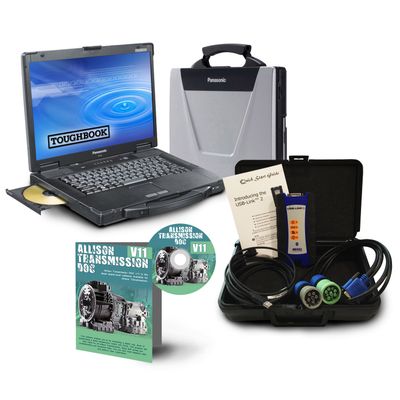
Every Allison kit we ship includes the current DOC license, the right adapter for your chassis mix, the cables, the laptop if you ordered the laptop kit, and our number for tech support. We carry the Allison Complete Fleet Diagnostic Kit, the Advanced Handheld Scanner for fault-clear and live data without a laptop, the standalone DOC software, the Adapter Bundle, and the J2534 Programming Interface for GM-platform 1000-series work. We can also pair Allison with the engine OEM software you'll need to do the rest of the truck — Cummins INSITE, Detroit DDDL, PACCAR ESA, or a multi-brand tool like JPRO or Jaltest. That cross-brand pairing is where most shops save money. One conversation, one quote, one shipment.

We support what we sell. If a tech runs into a connection issue, a calibration question, or a "what does this code actually mean" moment, we pick up the phone. Our staff has run these tools in actual shops, not just sold them.

Call 866-217-0063 for quick answers and help!

Frequently Asked Questions

What transmissions does Allison DOC cover?

The full Allison automatic line — 1000, 2000, 3000, 4000, B-Series, AT/MD/HD, and the more recent fully-electronic generations. DOC is the dealer-level tool for any of these.

Can DOC reset transmission shift adapt?

Yes. Shift adapt resets, neutral idle resets, oil level checks, prognostics resets, and calibration loads are all in DOC. The procedure varies by series.

Which adapter pairs with Allison DOC?

A Nexiq USB-Link 3 is the most common pairing for modern J1939 Allisons. Some older 1000/2000 series may need a dedicated Allison interface or a CAN-capable adapter — we will confirm based on your fleet.

Do I need DOC if my main tool is JPRO or Jaltest?

Aftermarket platforms read Allison codes and live data through J1939, but they do not load Allison calibration files or cover the full prognostics routines. If you do warranty Allison work or change calibrations, DOC is required.

View All FAQs →

Resources & Buyer Guides

HDT

Ready to Upgrade Your Diagnostic Game?

Our experts are here to help you choose the right Allison solution for your shop. Call now or shop online today.